Guide
Bulletproof windows for commercial buildings: ratings, frames and where they're needed
What makes a commercial window bullet resistant: EN 1063 glass ratings, EN 1522 ratings for the complete window, spall and no-spall builds, typical uses, and what to plan for when installing them.
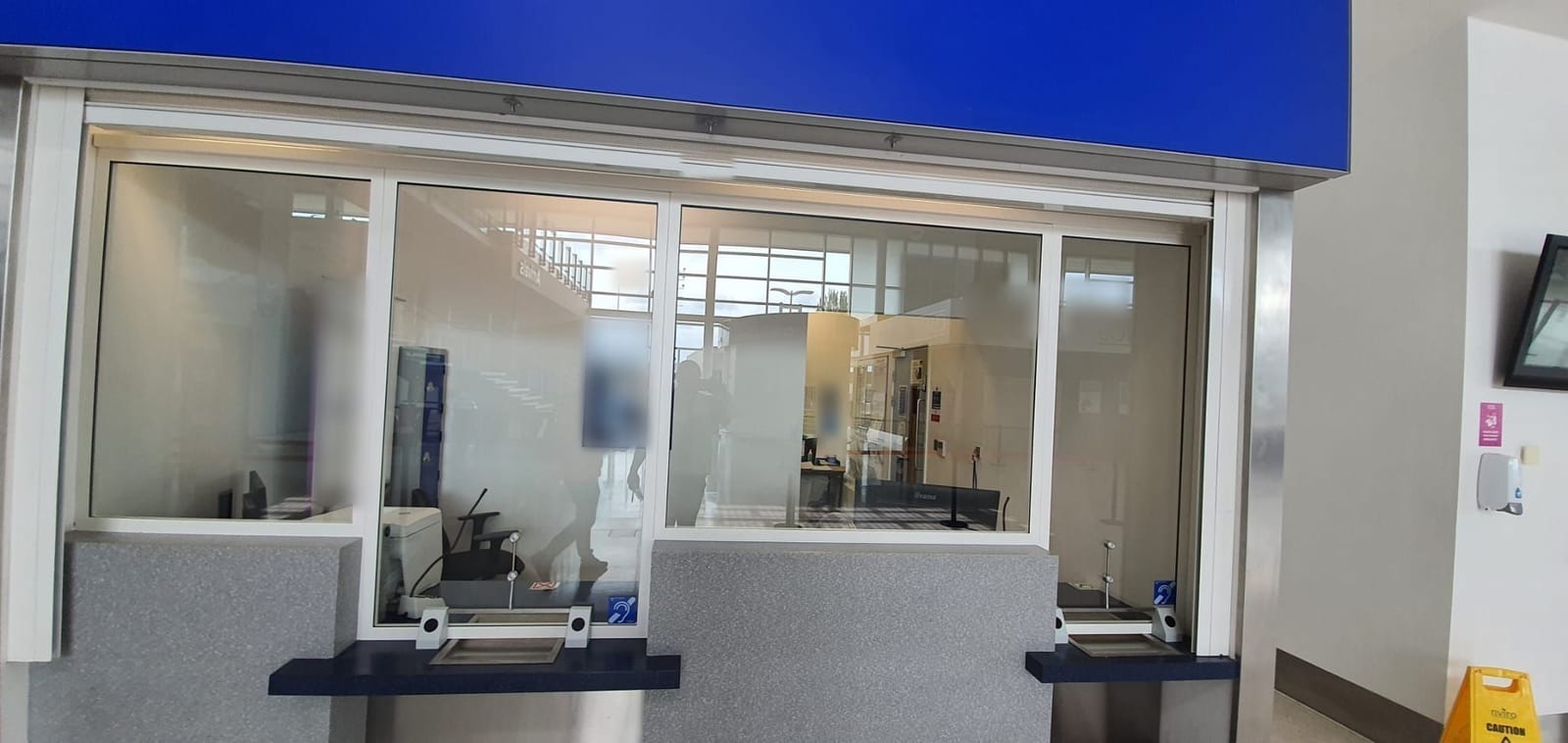
“Bulletproof window” is the term most people search for, but no window is bulletproof against everything. Bullet-resistant windows are tested against specific weapons and rounds, and their rating depends on the whole unit, not just the glass.
This guide explains how commercial bullet-resistant windows are rated, where they are used, and what to plan for when specifying one. For more on the glass itself, see our guide to bullet-resistant and attack-resistant glass.
Two standards: the glass and the complete window
| Standard | What it rates | Classes |
|---|---|---|
| EN 1063 | The glass on its own | BR1 to BR7, SG1 and SG2 |
| EN 1522 | The complete window, door or shutter, frame and fixings included | FB1 to FB7, FSG |
| BS 5051 | An older British standard for bullet-resistant glazing | Still seen in some specifications |
The difference matters. A pane of BR4 glass fitted into an ordinary aluminium frame is not a bullet-resistant window. A round that misses the glass can pass through the frame, the gap around it or the wall it is fixed to. EN 1522 tests the complete unit, so an FB rating covers the frame, the joint between glass and frame, and the fixings.
EN 1063 glass classes
| Class | Tested against |
|---|---|
| BR1 | .22 calibre rifle |
| BR2 | 9 mm handgun |
| BR3 | .357 Magnum handgun |
| BR4 | .44 Magnum handgun |
| BR5 | 5.56 mm rifle |
| BR6 | 7.62 mm rifle |
| BR7 | 7.62 mm rifle, hard-core round |
| SG1, SG2 | 12-bore shotgun slug |
EN 1522 uses matching FB classes for the complete unit: an FB4 window is tested against the same .44 Magnum threat as BR4 glass, and FSG covers the shotgun. See the glossary for FB4 and SG1 and SG2.
Spall and no-spall
When a bullet hits laminated glass, fragments can break off the protected side even if the bullet is stopped.
- S (spall): the round is stopped, but small fragments may fly off the inside face.
- NS (no spall): nothing breaks away from the protected side, usually achieved with a polycarbonate layer on the inside.
Where staff sit close behind the glass, specify no-spall. See the glossary entry on spall for more.
Where commercial bullet-resistant windows are used
| Location | Typical requirement |
|---|---|
| Cash counters and pay windows facing a firearms risk | BR4 glass in an FB4 unit, no-spall |
| Police station front counters and custody areas | As set by the force’s risk assessment |
| Reception screens in high-risk premises | FB-rated screens with matching doors |
| Data centre and control room observation windows | Rating matched to the threat assessment |
| External windows to high-risk rooms | FB-rated units fixed into a suitable wall |
Counters are the most common commercial application. A bullet-resistant counter line usually combines glazed security screens, a transfer unit to pass documents and cash, a speech system so staff and customers can hear each other, and a door to the secure side rated to match.
The weakest point
Every part of the protected line needs the same rating:
- Doors. A door beside an FB4 counter needs an equivalent rating, or it becomes the easiest way through. Specify the door to the same EN 1522 class as the counter, and confirm its rating in writing.
- Transfer trays. Trays and hatches pass through the protected line, so they need ballistic protection too. A ballistic tray with a shot box beneath it catches a round fired into the tray.
- Speech systems. Speech gaps in the glass weaken it. Electronic speech systems or protected speech paths avoid open holes.
- The wall. A rated window fixed into a plasterboard partition is only as strong as the partition.
Planning the installation
Bullet-resistant windows are made to measure. Before manufacture, a survey should confirm:
- The opening and structure. Bullet-resistant glass is far thicker and heavier than standard glazing, so the wall, lintel and fixings must carry the load.
- The full protected line, including doors, trays and any service penetrations.
- Other requirements such as fire rating, sound attenuation or accessible counter heights.
- Access for installation, since large glazed units may need lifting equipment.
An example specification
Our bullet-resistant pay window is a typical high-risk counter unit:
| Item | Specification |
|---|---|
| Glazing | 26mm BR4/SG1/NS to EN 1063 |
| Complete unit | Designed to resist BS EN 1522 FB4 |
| Aperture | W 610mm × H 1120mm |
| Transfer | Ballistic cash packet audio tray with under-counter shot box |
Our bullet-resistant glass is available in spall and no-spall builds to BS 5051, BS EN 1522 and BS EN 1063, with fire-rated and sound-attenuating options.
Questions to ask a supplier
- Is the rating for the glass alone, or for the complete unit?
- Which standard and class, and is there test evidence?
- Is the build spall or no-spall?
- Are the adjacent doors, trays and speech paths rated to match?
- Is the wall or opening strong enough, and who confirms it?
- Does the window need to be fire rated or sound attenuating?
We design, manufacture and install bullet-resistant counters, screens, pay windows and doors in our own Edenbridge workshop. Request a free site survey or read more about our security screens and counters.
Frequently asked questions
What is the difference between bulletproof glass and a bulletproof window?
Bulletproof glass is rated on its own under EN 1063. A bulletproof window is the glass, frame, fixings and any openings together, rated under EN 1522. A BR4 pane in an unrated frame does not make an FB4 window.
What level of bulletproof glass do I need?
That comes from a risk assessment. For counters where a handgun threat is identified, BR4 glass in an FB4-rated unit is a common specification. Rifle threats need BR5 to BR7, and shotgun threats need an SG or FSG rating.
What does no-spall mean?
No-spall (NS) means nothing breaks away from the protected side when the glass is hit. Spall (S) means the bullet is stopped but small fragments may fly off the inside. Where staff sit close behind the glass, specify no-spall.
Are bulletproof windows heavy?
Yes. Bullet-resistant glass is much thicker than standard glazing, so frames, fixings and the surrounding structure must be designed to carry it. A survey confirms that the wall or opening is suitable before manufacture.
Can bulletproof windows also be fire rated?
Bullet-resistant glass can be supplied in fire-rated and sound-attenuating builds. The complete window must be specified for both, so confirm the requirement at the start of the design.