Guide
EN 1063 or EN 356? Choosing glass for a security counter
Attack-resistant and bullet-resistant glass are tested against different threats. What each rating means, and how to choose for a reception, cash office or front counter.
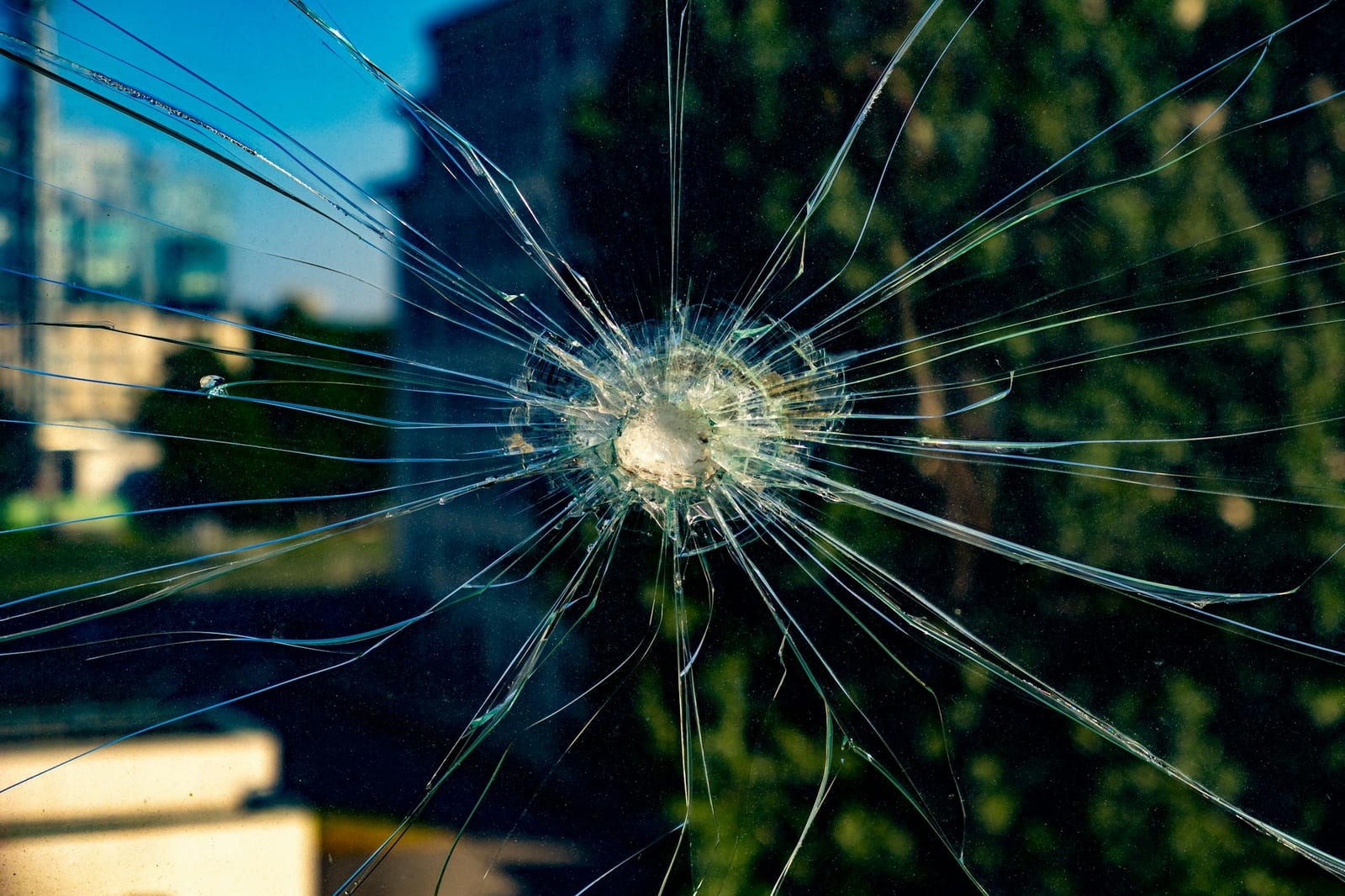
Security glass is rated against one of two kinds of threat. EN 356 covers manual attack: someone hitting, kicking or throwing things at the glass. EN 1063 covers firearms. The two standards test different things, so a high rating in one says nothing about the other.
For most counters the question is how much manual attack the glass has to hold off. Bullet resistance comes in when the risk assessment reaches firearms.
What EN 356 tests
EN 356 rates laminated glass against deliberate manual attack. It has two groups of classes.
P1A to P5A use a 4.11 kg steel ball dropped onto the glass from a set height, three times in a triangle pattern. To pass, the ball must not go through.
| Class | Drop height | Strikes |
|---|---|---|
| P1A | 1.5 m | 3 |
| P2A | 3 m | 3 |
| P3A | 6 m | 3 |
| P4A | 9 m | 3 |
| P5A | 9 m | 9 |
P6B to P8B are tested with a hammer and an axe. The glass is broken, then cut until there’s a 400 × 400 mm opening. The class depends on how many blows that takes: 30 to 50 for P6B, 51 to 70 for P7B, and more than 70 for P8B.
P4A is the usual starting point for a counter. It’s the rating on our standard pay windows and glazed screens. It holds up against the realistic threat at most receptions, pharmacies and enquiry windows: someone hitting the glass, or throwing a chair or bottle at it. The P-B classes are for higher-risk settings, where someone may come prepared with tools and time.
What EN 1063 tests: BR1 to BR7 and BR4 glass
BR4 glass is bullet-resistant glass that has passed the EN 1063 test against a .44 Magnum handgun round, the class most often specified for counters where firearms are a risk. It’s what bulletproof counter screens are usually glazed with.
EN 1063 rates glass against shots from specific weapons at set distances and speeds. A pane that passes a higher class also passes the classes below it.
| Class | Threat it’s tested against |
|---|---|
| BR1 | .22 calibre rifle |
| BR2 | 9 mm handgun |
| BR3 | .357 Magnum handgun |
| BR4 | .44 Magnum handgun |
| BR5 | 5.56 mm rifle |
| BR6 | 7.62 mm rifle |
| BR7 | 7.62 mm rifle, hard-core round |
| SG1, SG2 | 12-bore shotgun slug |
Every class also carries a splinter rating:
- S (spall): the glass stops the round, but small fragments may break off the protected side.
- NS (no spall): nothing breaks away from the protected side. Builds usually achieve this with a polycarbonate layer on the inside face.
Where staff sit close behind the glass, specify NS.
Our bullet-resistant pay window is glazed to BR4/SG1/NS: tested against a .44 Magnum handgun and a shotgun slug, with no spall. You’ll also see BS 5051 on some specifications. It’s an older British standard for bullet-resistant glazing and still turns up in tenders, so we quote to it where asked.
The two side by side
| Compared | Attack-resistant (EN 356) | Bullet-resistant (EN 1063) |
|---|---|---|
| Tested against | Hitting, kicking, thrown objects, tools | Firearms, by weapon class |
| Typical counter rating | P4A | BR4/SG1/NS where firearms are a risk |
| Typical settings | Receptions, pharmacies, GP surgeries, ticket and enquiry windows | Police front counters, cash offices, banks, high-value retail |
| Build | Laminated glass with interlayers | Thicker multi-layer laminate, often with polycarbonate |
| Effect on the counter | Standard frames and fixings | Heavier glass, so a stronger frame and fixings |
The glass is only as strong as the counter around it
A rated pane is one part of a rated counter. The weak points are usually around the glass, not in it.
- The frame. The glass has to be held in a frame that resists the same attack. For doors and windows, EN 1522 rates the complete unit, not just the glass. Our bullet-resistant pay window is designed to resist FB4 to EN 1522 as a whole unit, not just BR4 in the glass.
- The transfer tray. An open gap under the glass is a way through. A transfer tray lets cash and documents pass without opening a gap. On a bullet-resistant counter the tray has to be ballistic too: ours uses a ballistic audio tray with an under-counter shot box.
- Speech. Staff and customers still have to hear each other. Speech gaps and speech transfer systems are designed into the screen, so talking through it doesn’t weaken it.
- The wall and the counter. Bullet-resistant glass is heavy. What it’s fixed to has to carry the load and the attack.
We make our screens and pay windows to the opening in our own workshop and fit them, with the whole unit rated. See security screens and counters.
How to decide
Work through these before choosing a rating:
- The risk assessment. What has actually happened at this site, or at similar ones? Assault and thrown objects point to EN 356. A credible firearms risk points to EN 1063.
- Your insurer or the tender. Many specify a minimum rating. That sets the floor.
- Who sits behind the glass, and how close. Close staff positions are a reason to choose no-spall builds.
- The opening and the counter. Thicker glass needs stronger frames and fixings, and sometimes changes to the counter.
- Access. Low-level positions for wheelchair users and hearing loops at speech points are usually needed too. Our low-level pay windows are built for this, and our guide to accessible security counters sets out the dimensions.
- Day-to-day use. How cash, documents and parcels pass through, and how people talk, decide the tray and the speech system. Our guide to choosing a pay window, tray or hatch covers the options.
If you’re not sure where your site sits, a survey settles it. We look at the counter, the risk and how it’s used, then specify the rating. You can also download our bullet-resistant glass tech sheet and the glazed screens tech sheet.
Questions people ask
Is P4A glass bullet resistant?
No. P4A is an EN 356 rating for manual attack: thrown and swung objects. It isn't tested against firearms. For that you need glass rated to EN 1063, such as BR4.
What does BR4/SG1/NS mean?
BR4 is the EN 1063 class tested with a .44 Magnum handgun round. SG1 adds a shotgun slug test. NS means no spall: nothing breaks away from the protected side when the glass is hit.
Do I need bullet-resistant glass at a reception counter?
Only if the risk assessment, your insurer or the tender specification calls for it. Most receptions, pharmacies and enquiry windows face assault and thrown objects, which attack-resistant glazing to EN 356 is designed for.
Is the glass rating enough on its own?
No. A rated pane in an unrated frame, or next to an open transfer gap, isn't a rated counter. The frame, the fixings and any tray or speech panel need to match the glass.
Can you fit new security glass into an existing counter?
Often, yes. Screens can be made to fit a counter you already have or a prepared opening, provided the counter and the wall can take the extra weight and fixings. We check this at survey.