Guide
Pay window, transfer tray or hatch? Choosing how things cross a secure counter
How to choose between a pay window, transfer tray, sliding hatch or bulk transfer unit, starting from what has to cross the counter, how people talk, and the risk.
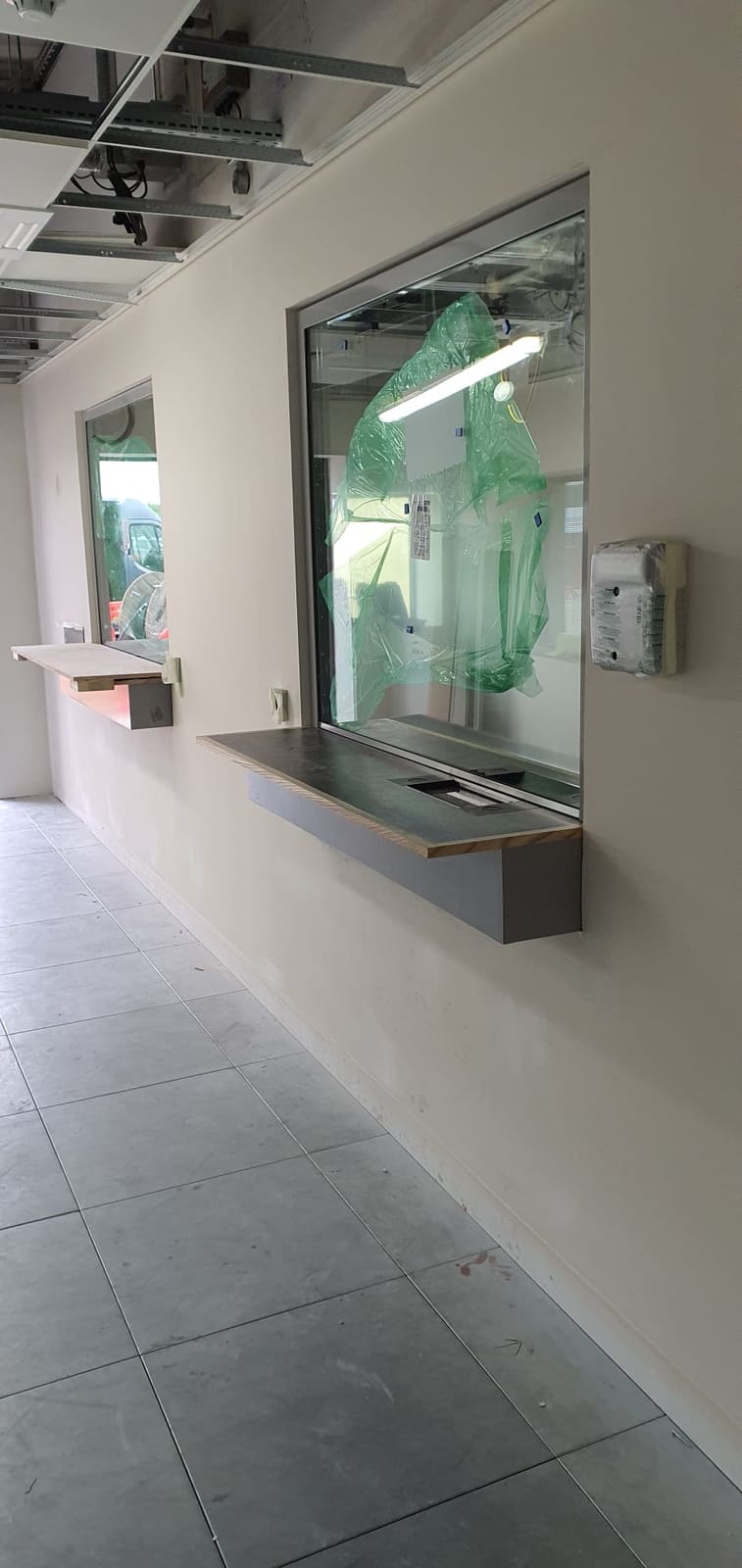
The screen is the part of a secure counter everyone notices, but the hardest decision is usually the small one underneath it: how things get from one side to the other. Get that right and the counter works all day without staff leaning round the glass or propping a gap open.
This guide starts from what has to cross the counter, then goes through each option we make, with a comparison table at the end. For the glass itself, see our guide to attack-resistant and bullet-resistant glass.
Start with what crosses the counter
Three questions settle most counters:
- What passes through? Paper only, cash and cards, small packets, or bulkier items such as property bags or boxed medicines.
- Can people hear each other? Glass blocks speech. A quiet counter can rely on natural speech through the mullions. A busy one, or one used by people with hearing aids, needs electronic speech enhancement and a hearing loop.
- What’s the threat? Most counters need protection against manual attack: someone hitting the glass or throwing things at it. A risk assessment that identifies a firearms threat moves you to ballistic products.
Two more come up at survey: whether the counter needs a seated position for wheelchair users, and whether the opening is in an internal counter or an external wall.
Pay windows: the standard counter unit
A pay window is the glazed unit that sits on the counter, with the tray built in beneath the glass. It’s the usual answer for cash offices, dispensaries, ticket offices and reception counters. Our PW range comes in four builds, all glazed to 11.5mm BS EN 356 P4A:
- PW1: natural speech through the mullions, no tray
- PW2: a cash packet tray, 110mm deep, for documents, cash and small packages
- PW3: a 75mm audio tray with electronic speech enhancement and a hearing loop
- PW4: a 25mm shallow document tray with the same audio system
Three variations cover the cases the standard range doesn’t:
- Low-level pay windows (LLPW1 to LLPW4) put the opening at seated height, so a wheelchair user is served at the main counter rather than sent to a side window. LLPW3 and LLPW4 have a built-in hearing loop.
- The bullet-resistant pay window (BRPW) is for counters where the risk assessment identifies a firearms threat. It has 26mm BR4/SG1/NS glazing to EN 1063, is designed to resist BS EN 1522 FB4 as a whole unit, and uses a cash packet audio tray over an under-counter shot box.
- The flush-fit pay window is for serving through an external wall, at a garage forecourt or a 24-hour pharmacy. It sits flush with the building, and its drawer locks from the inside.
Transfer trays: when the screen is already there
A transfer tray is the stainless steel tray set into the counter beneath the screen. Choose a tray on its own when you already have a screen, or when a run of glazed screens needs a transfer point. Our transfer trays come in four versions:
| Tray | What passes | Depth | Speech | Prepared opening |
|---|---|---|---|---|
| Shallow document tray | Documents | 25mm | None built in | 400mm × 344mm |
| Cash packet tray | Packets and documents | 25mm closed, 110mm open | None built in | 400mm × 344mm |
| Audio tray | Documents and cash | 75mm | Electronic speech and hearing loop | 420mm × 350mm |
| Ballistic audio tray | Documents and cash | 70mm | Electronic speech and hearing loop | 500mm wide × 420mm deep |
Each tray fits a prepared opening in the counter, with a rebate so it sits flush. The ballistic audio tray is tested and certified by a UK accredited test house to BS EN 1522 FB4 and SG1, and includes an under-counter shot box. The audio trays need a 13amp socket. None of the trays is for external use.
All-in-one units: the CW2 and the BTW1
Two units combine the glazing and the transfer point, so nothing separate has to be cut into the counter:
- The CW2 cash window pairs 11.5mm P4A glazing with a 110mm cash packet tray and natural speech through the mullions. It’s a compact choice for cash and ticket offices.
- The BTW1 budget transfer window has 11.5mm 3-ply attack-resistant glazing over a latched transfer opening, 465mm wide by 170mm high. There’s no tray and no speech system. Staff pass documents and small items through the opening and latch it shut, and the window locks with a night latch.
Sliding hatches: an opening that shuts
A tray leaves no gap, but some counters need a real opening for part of the day: a serving hatch, a stores counter, a reception that hands over larger items. A sliding hatch gives you an opening that closes and locks instead of a permanent gap.
Our sliding hatches come in vertical and horizontal versions, with the same 11.5mm P4A glazing, steel framing and Abloy cylinder pin lock. A vertical hatch slides up and a horizontal hatch slides sideways, so the choice comes down to the space around the opening. Both are made to order, in bespoke sizes within a 2 to 1 height ratio.
Bulk items: the EBTU
When items are too big for any tray, such as property at a custody desk or larger items at a pharmacy, use a bulk transfer unit.
The EBTU has two electronically interlocked doors, so the secure side is never open to the public side. It’s built to ballistic resistance BS 5051 G2 S86, mounts in a wall or on a counter in left or right hand versions, and needs a 13amp socket for the interlock.
Side by side
| Option | What passes | Speech | Power | Rating | Where |
|---|---|---|---|---|---|
| Pay window PW1 to PW4 | Depends on build: none, documents, cash or packets | Natural (PW1, PW2) or electronic with hearing loop (PW3, PW4) | PW3 and PW4 | BS EN 356 P4A | Internal counter |
| Low-level pay window | Documents, cash or packets | Natural (LLPW1, LLPW2) or electronic with hearing loop (LLPW3, LLPW4) | LLPW3 and LLPW4 | BS EN 356 P4A | Internal counter, seated height |
| Bullet-resistant pay window | Documents and cash, to 100mm | Electronic with hearing loop | Yes | BR4/SG1/NS to EN 1063, designed to resist EN 1522 FB4 | Internal counter |
| Flush-fit pay window | Goods, through a flush draw unit | Audio with induction loop | Yes, within 1m | BS EN 356 P4A | External wall, under a canopy |
| Transfer tray | Documents, cash or packets | Electronic on audio versions | Audio versions | Attack resistant; ballistic version FB4 and SG1 | Internal counter |
| CW2 cash window | Documents, cash and small packages, 110mm | Natural | No | BS EN 356 P4A | Internal counter |
| BTW1 | Documents and small items, through a 465 × 170mm opening | None built in | No | Attack-resistant 11.5mm 3-ply | Internal counter |
| Sliding hatch | Anything that fits the opening | Through the open hatch | No | BS EN 356 P4A | Counter or wall |
| EBTU | Bulk items | None | Yes | BS 5051 G2 S86 | Wall or counter |
Joining them into one protected line
Most real counters use more than one of these. A typical public counter might have two standard pay windows, a low-level window for seated customers, a sliding hatch at the end for larger items and a door through to the staff side, all in one run.
We make them in our Edenbridge workshop to fit together, so the frames, glazing heights and finish match along the whole line. Where the risk reaches firearms, the BRPW joins with FB4 doors and ballistic trays, so the line has no weak point. Where conversations are hard, speech transfer systems and the hearing loop options carry the sound through the glass.
Not sure which combination your counter needs? We start with a free site survey, then specify each position. Talk to us about your counter, or see our security screens and counters and transfer units and hatches.
Questions people ask
What is a transfer tray?
A stainless steel tray set into the counter beneath the screen. Documents, cash or packets pass between the public side and the staff side without an open gap under the glass. There are shallow document, cash packet, audio and ballistic audio versions.
Can I add a tray to the screen I already have?
Often, yes. Trays fit a prepared opening in the counter, not the screen itself, with a rebate so they sit flush. The opening sizes are on each tray's tech sheet. We check at the site survey whether your counter and screen can take one.
Which options need a power socket?
Anything with electronic speech or an interlock: the PW3 and PW4 pay windows, the LLPW3 and LLPW4 low-level windows, the BRPW, the audio and ballistic audio trays, the flush-fit pay window (a socket within one metre) and the bulk transfer unit. Each needs a 13amp socket.
Which option is most secure?
It depends on the threat. For someone hitting or throwing things at the glass, BS EN 356 P4A glazing covers it, and that's standard across the range. Where the risk assessment reaches firearms, use the BRPW (BR4/SG1/NS glazing, designed to resist BS EN 1522 FB4), the ballistic audio tray with its shot box, and for bulk items the EBTU, built to BS 5051 G2 S86.
Can any of these be used in an external wall?
The flush-fit pay window is the one designed for it: it sits flush with the face of the building and is best installed under a canopy. The standard pay windows, low-level windows and trays are for internal counters only.