Guide
Protecting reception staff from violence and abuse
An employer's duty to protect front-line staff, how to assess the risk at a counter, and where layout, screens, speech systems, alarms and CCTV fit in.
This is general guidance, not legal advice. Check HSE’s current guidance when you write your own risk assessment.
Receptions, counters and front desks are where staff meet people who are frightened, frustrated, in pain or angry. Most visits are fine, but abuse and violence at the front desk are common enough that every employer with a public counter needs a plan.
This guide covers the employer’s duty, how to assess the risk at a counter, and where physical measures such as screens fit. The short version: physical protection comes after the risk assessment, not instead of it.
The duty
HSE is clear that health and safety law applies to work-related violence just as it does to other risks:
- The Health and Safety at Work Act requires employers to protect workers’ health, safety and welfare so far as reasonably practicable, including from violence.
- The Management of Health and Safety at Work Regulations require a risk assessment that covers the risk of violence, along with information and training for staff.
- RIDDOR requires you to report violence at work that causes a death, a specified injury, or an injury that keeps someone off their normal duties for more than seven days. Injuries of more than three days must be recorded.
- Consultation rules require you to consult staff, or their representatives, on health and safety.
HSE counts verbal and online abuse as hazards, not just physical assault. In the NHS, the Violence Prevention and Reduction Standard sets out what organisations should do, including the physical environment.
Assessing the risk at a counter
HSE’s approach is to identify the hazards, decide how likely and serious harm is, then decide how to control it. At a counter, that means asking:
- What has happened here? Look back at incident records, and ask staff directly. Many incidents never get recorded.
- When does it happen? Opening time, the end of the day, when there are delays, or when bad news is given.
- Who is most at risk? HSE highlights lone workers, new starters and temporary staff.
- What’s the worst realistic outcome? Shouting, things thrown, someone reaching or climbing over the counter, or, in a few settings, weapons.
Write down what you find and review it regularly, especially after an incident.
Layout and procedures first
HSE says no single control is enough on its own, and many of the most effective ones cost little:
- Visibility and lighting. Staff should see the whole waiting area and the entrance, with no blind spots.
- Queuing. A clear queuing system stops tension building at the counter.
- Information. Telling people about delays and waiting times prevents a lot of frustration.
- Staffing. Enough people at busy times, and nobody left alone at the counter when risk is higher.
- Training. De-escalation training for everyone who works at the front, including temporary staff.
- Exits. A clear route away from the counter for staff, which visitors can’t use to get behind it.
Screens and their ratings
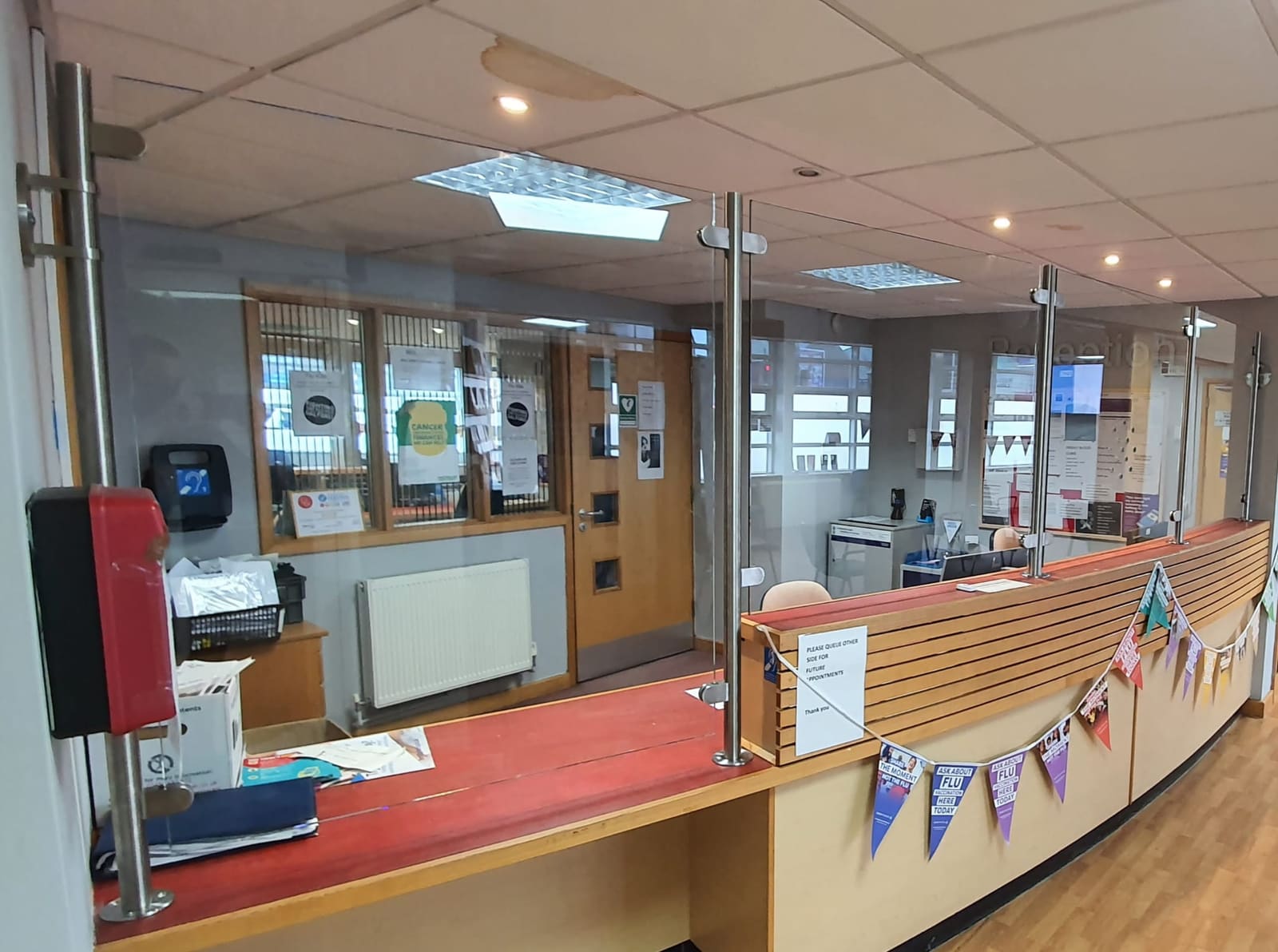
Where the assessment still finds a real risk of assault or thrown objects, a screen separates staff from the public without stopping them serving. Choose the rating to match the threat:
- BS EN 356 P4A is the usual starting point. It’s a manual-attack rating: the glass is struck repeatedly by a heavy steel ball and must not be breached. It holds against someone hitting the glass or throwing things at it. Our glazed screens and pay windows use 11.5mm P4A glazing.
- EN 1063 and BS EN 1522 apply where the risk assessment identifies a firearms threat, as at some police and cash counters. The bullet-resistant pay window uses 26mm BR4/SG1/NS glazing and is designed to resist BS EN 1522 FB4 as a whole unit.
A screen is only as strong as its weakest point, so the frame, fixings and any openings matter as much as the glass. Our guide to attack-resistant and bullet-resistant glass explains the ratings in more detail.
Passing things and talking through the glass
A screen that makes the counter hard to use creates its own frustration. Two details make the difference:
- Transfer. A transfer tray set into the counter lets documents, cash or packets cross without an open gap under the glass. Our guide to choosing a pay window, tray or hatch covers the options.
- Speech. If people have to shout to be heard, tempers rise. Natural speech through the mullions suits quiet counters. Busy ones need electronic speech enhancement, and a speech transfer system or an audio tray with a hearing loop also helps visitors who use hearing aids.
Alarms, CCTV and recording incidents
HSE lists CCTV, alarm systems and signage among the workplace controls. They deter some incidents and provide evidence for the police when they happen.
- CCTV covering the counter, the waiting area and the entrance, with signs that make it obvious. See our guide to CCTV signs and our commercial CCTV service.
- Alarms so staff can summon help quickly, with an agreed response.
- Signage reminding visitors to treat staff with respect.
- Recording. HSE recommends a quick, easy way for staff to record incidents, because a recording system nobody uses tells you nothing. Report crimes to the police on 101 or online.
Matching measures to the risk
| Risk found at the counter | Typical measures |
|---|---|
| Occasional frustration, no history of assault | Layout, queuing, information about delays, training, CCTV and signage |
| Verbal abuse and threats, occasional thrown objects | All of the above, plus a P4A screen with transfer trays and speech, and alarms |
| Assaults or attempts to get over the counter | A full-height P4A screen line with hatches and doors, alarms, CCTV and staffing at busy times |
| Firearms threat identified | Bullet-resistant glazing and units rated to BS EN 1522, ballistic trays, and a protected door line |
Notes by sector
- GP surgeries and hospitals. Receptions and A&E deal with people who are anxious, in pain or under the influence. Screens need to work with speech systems, hearing loops and privacy panels, and the Equality Act applies to the counter too. See hospitals and healthcare.
- Police front counters. The risk assessment may reach firearms, and counters often join with custody and interview rooms. See police stations and custody.
- Schools and colleges. Reception is also the safeguarding point, controlling who gets into the building. See schools and colleges.
- Councils and public offices. Housing, benefits and enquiry counters see the same frustrations, often with long waits. Good information about waiting times and a well-designed counter do much of the work.
Reviewing protection at a reception or counter? We survey for free, look at how the counter is used, and specify screens, trays and speech to match your risk assessment. Talk to us about your counter, or see our security screens and counters.
Questions people ask
Is an employer legally required to protect staff from abuse?
Yes. The Health and Safety at Work Act requires employers to protect workers' health and safety so far as reasonably practicable, and HSE says that includes work-related violence. The Management Regulations require a risk assessment that covers it, and HSE counts verbal and online abuse as well as physical assault.
Do reception staff need a screen?
Not always. It depends on the risk assessment. Many receptions are made safer by layout, queuing, staffing and training alone. A screen is the right answer where the assessment finds a real risk of assault or thrown objects that those measures can't control.
What rating should a reception screen be?
For most receptions, glazing to BS EN 356 P4A, which resists repeated blows and thrown objects. Where the risk assessment identifies a firearms threat, as at some police and cash counters, bullet-resistant glazing to EN 1063 and a unit rated to BS EN 1522 are needed.
Can screens make reception feel hostile?
They can if they're an afterthought. A screen designed with the counter, with clear glass, a warm worktop, a speech system so nobody has to shout, and a seated position, feels very different from a sheet of glass bolted to a desk. Good information about waiting times helps more than any screen.
Should we record incidents?
Yes. HSE says recording incidents helps you understand the risks and check your controls are working, and shows staff you take it seriously. Some injuries from violence must also be reported to HSE under RIDDOR.